Why I added SDA to my omega-3 supplement
A closer look at how the body makes DHA and EPA, why plant omega-3s fall short, and why I now recommend higher omega-3 levels than I used to
For years, I have recommended that anyone who does not eat fish take a modest dose of algae-derived DHA and EPA. That advice has not changed. What has changed is how much I recommend, and how we get there. After reviewing the newest research on omega-3 status and brain aging, I increased the doses of DHA and EPA.
Another change: I added a lesser-known omega-3 called stearidonic acid, or SDA, from Ahiflower®. To understand why, it helps to look at how the body makes these omega-3 fatty acids.
Why ALA from seeds and walnuts is not enough
Flax, chia, and hemp seeds and walnuts are rich in alpha-linolenic acid (ALA), the short-chain omega-3 found in plants. I recommend eating them every day. But studies have shown that increasing ALA intake does not translate into higher levels of DHA and EPA, the long-chain omega-3 fatty acids the brain depends on.1
DHA makes up about a quarter of the fatty acids in the cerebral cortex and is important for cognitive function.2 EPA plays key roles in mood and in regulating and resolving inflammation.3-5 The body can make both from ALA, but in most people, not very much. Studies using labeled ALA estimate that less than 1 percent is converted to DHA.6 Supplementing with ALA, even at 6 to 8 grams a day, does not raise the omega-3 index, the percentage of EPA plus DHA in red blood cell membranes.1
Related: Why Vegans Need DHA and EPA
Sources:
Bioavailability and conversion of plant based sources of omega-3 fatty acids - a scoping review to update supplementation options for vegetarians and vegans
Expert Opinion on Benefits of Long-Chain Omega-3 Fatty Acids (DHA and EPA) in Aging and Clinical Nutrition
Long-chain omega-3 fatty acids and the brain: a review of the independent and shared effects of EPA, DPA and DHA
Very long-chain n-3 fatty acids and human health: fact, fiction and the future
Omega-3 fatty acids and inflammatory processes
Metabolism and functional effects of plant-derived omega-3 fatty acids in humans
This shows up clearly in vegans. In one study, vegans not taking supplements averaged an omega-3 index of 3.7 percent, and more than a quarter were below 3 percent, even though their average ALA intake was more than double the recommended amount.7 The Adventist Health Study 2 found similarly low levels in vegans not taking EPA and DHA, and ALA intake did not predict who had higher levels.8
The issue is not limited to vegans and vegetarians. On average, omega-3 index in omnivores is also suboptimal. In U.S. adults, the average omega-3 index is only 4.25%, according to a recent analysis of data from the CDC’s National Health and Nutrition Examination Survey.9
This matters because low omega-3 levels are consistently linked to faster brain aging, including smaller total brain and hippocampal volumes.10-17
Sources:
Dietary and erythrocyte PUFAs in vegan, lacto-ovo vegetarian, pesco-vegetarian, and non-vegetarian participants of the Adventist Health Study-2
Over Half of the United States Population Had an Undesirably Low Omega-3 Index Based on Erythrocyte Membrane Measurements: Results From the Cross-Sectional NHANES From August 2021 to August 2023
Red blood cell omega-3 fatty acid levels and markers of accelerated brain aging
Associations of erythrocyte omega-3 fatty acids with cognition, brain imaging and biomarkers in the Alzheimer's disease neuroimaging initiative: cross-sectional and longitudinal retrospective analyses
Association of Red Blood Cell Omega-3 Fatty Acids With MRI Markers and Cognitive Function in Midlife: The Framingham Heart Study
Circulating Omega-3 Polyunsaturated Fatty Acids and Subclinical Brain Abnormalities on MRI in Older Adults: The Cardiovascular Health Study
The long journey from ALA to DHA
Converting ALA to DHA is a multistep process. Enzymes called desaturases add double bonds to the fatty acid chain, and enzymes called elongases add carbon atoms to elongate the chain.
- Delta-6 desaturase converts alpha-linolenic acid (ALA) to SDA. This is the first step and the rate-limiting one. It is the step that limits the pace for the rest of the process. Delta-6 desaturase adds a double bond to ALA, producing stearidonic acid (SDA)
- An elongase adds two carbon atoms to SDA, producing eicosatetraenoic acid (ETA).
- Delta-5 desaturase adds a double bond, converting ETA to eicosapentaenoic acid (EPA).
- Two elongation steps add carbon atoms, converting EPA to docosapentaenoic acid (DPA), and then to 24:5 n-3.
- Delta-6 desaturase is needed a second time. Another double bond is added, producing 24:6 n-3.
- Beta oxidation shortens the fatty acid chain, removing two carbons to produce docosahexaenoic acid (DHA).18
It’s important to note that most ALA never gets started in the desaturation and elongation process; much of it is simply burned for energy. Genetic variants in the genes encoding the enzymes, sex, insulin resistance, micronutrient adequacy, and omega-6 fatty acids all influence the activity of these enzymes, which is why conversion varies so widely from person to person.19,20
Sources:
Elongase reactions as control points in long-chain polyunsaturated fatty acid synthesis
An analysis of omega-3 clinical trials and a call for personalized supplementation for dementia prevention
Omega-3 fatty acids in vegetarian and vegan diets: Translating evidence into practice
Where SDA fits in
SDA is the product of that first, rate-limiting step. Taking SDA directly lets the body skip the bottleneck, producing more ETA and then EPA. One of the richest sources of SDA is Ahiflower® (Buglossoides arvensis) oil, which is about 20 percent SDA, along with ALA and a small amount of the beneficial omega-6 GLA. ALA and GLA both contribute to healthy skin.21
Human trials show the advantage of SDA over ALA. In a randomized trial comparing Ahiflower® oil with flaxseed oil, Ahiflower® raised EPA in plasma and red and white blood cells significantly more than flaxseed oil did.22 A second trial found Ahiflower® raised EPA in a dose-dependent manner, even at the lowest dose tested, and increased production of the anti-inflammatory signaling molecule interleukin-10 (IL-10).23 A controlled comparison of isolated omega-3s found SDA was roughly four times as effective as ALA at raising plasma and red blood cell EPA.24 Compared with pre-formed EPA itself, SDA is roughly 30 percent as efficient at raising EPA levels.24
But there is one thing SDA cannot do: it does not raise DHA levels. Study after study shows that SDA increases EPA and DPA while DHA levels stay flat.23-27 That second delta-6 desaturase step is still in the way. This is exactly why SDA does not replace pre-formed DHA. It complements it.
Sources:
Diet and Skin Barrier: The Role of Dietary Interventions on Skin Barrier Function
Consumption of Buglossoides arvensis seed oil is safe and increases tissue long-chain n-3 fatty acid content more than flax seed oil - results of a phase I randomised clinical trial
Dietary Buglossoides Arvensis Oil Increases Circulating n-3 Polyunsaturated Fatty Acids in a Dose-Dependent Manner and Enhances Lipopolysaccharide-Stimulated Whole Blood Interleukin-10-A Randomized Placebo-Controlled Trial
Metabolism of stearidonic acid in human subjects: comparison with the metabolism of other n−3 fatty acids
Stearidonic acid improves eicosapentaenoic acid status: studies in humans and cultured hepatocytes
If we are already supplying EPA and DHA, why add SDA?
Scientists are studying whether SDA has benefits of its own, not just as a precursor to EPA. Taking EPA and DHA doesn’t increase the production of SDA from ALA, since it’s an earlier step in the conversion process. Laboratory studies suggest SDA may quiet inflammatory signaling and support vascular function and a healthy microbiome.28-30 In humans, Ahiflower® oil increased anti-inflammatory compounds made from EPA while modestly lowering some inflammatory compounds made from the omega-6 arachidonic acid.27 These findings are preliminary, but they point in a consistent direction.
The 100 milligrams of SDA in my new formula is a conservative dose meant to complement ALA, EPA, and DHA. Combined with a daily diet rich in flax, chia, hemp seeds, and walnuts, this comprehensive supplement supplies omega-3s at the beginning, middle, and the end of the pathway.
Sources:
Beneficial effects of Ahiflower (Buglossoides arvensis) oil on hyperlipidemia and thrombosis
Stearidonic acid (18:4n-3): Sources, metabolism, and health effects-a systematic review
Human gut microbiota and their production of endocannabinoid-like mediators are directly affected by a dietary oil
Why I increased the DHA and EPA
My original formula supplied 175 mg DHA and 88 mg EPA. This formula was enough to move many vegans out of the deficient range (less than 4%), according to a 2014 study, where the average omega-3 index increased from 3.1% to 4.8% over 4 months of supplementation.7
Adequacy is important, but excess could have negative effects. Low omega-3 levels and low omega-3 intake are associated with a higher risk of atrial fibrillation.31-34 High doses of EPA are appropriate in the context of certain medical conditions, but not for everyone. I remain cautious because doses above 1 gram daily, especially of EPA, have also been associated with an increased risk of atrial fibrillation in some studies.35 That caution still holds, but the research on brain health and longevity related to the omega-3 index has sharpened my target omega-3 index.
An omega-3 index below 4% is associated with the highest risk of death from heart disease, and an index above 8% with the lowest.36 Brain imaging studies in older adults suggest at least 6 percent is needed for healthy brain aging.10,11 In the Framingham Offspring cohort, people in their mid-sixties in the highest fifth of omega-3 index (above 6.8%) lived nearly five years longer, on average, than those in the lowest fifth (below 4.2%).37
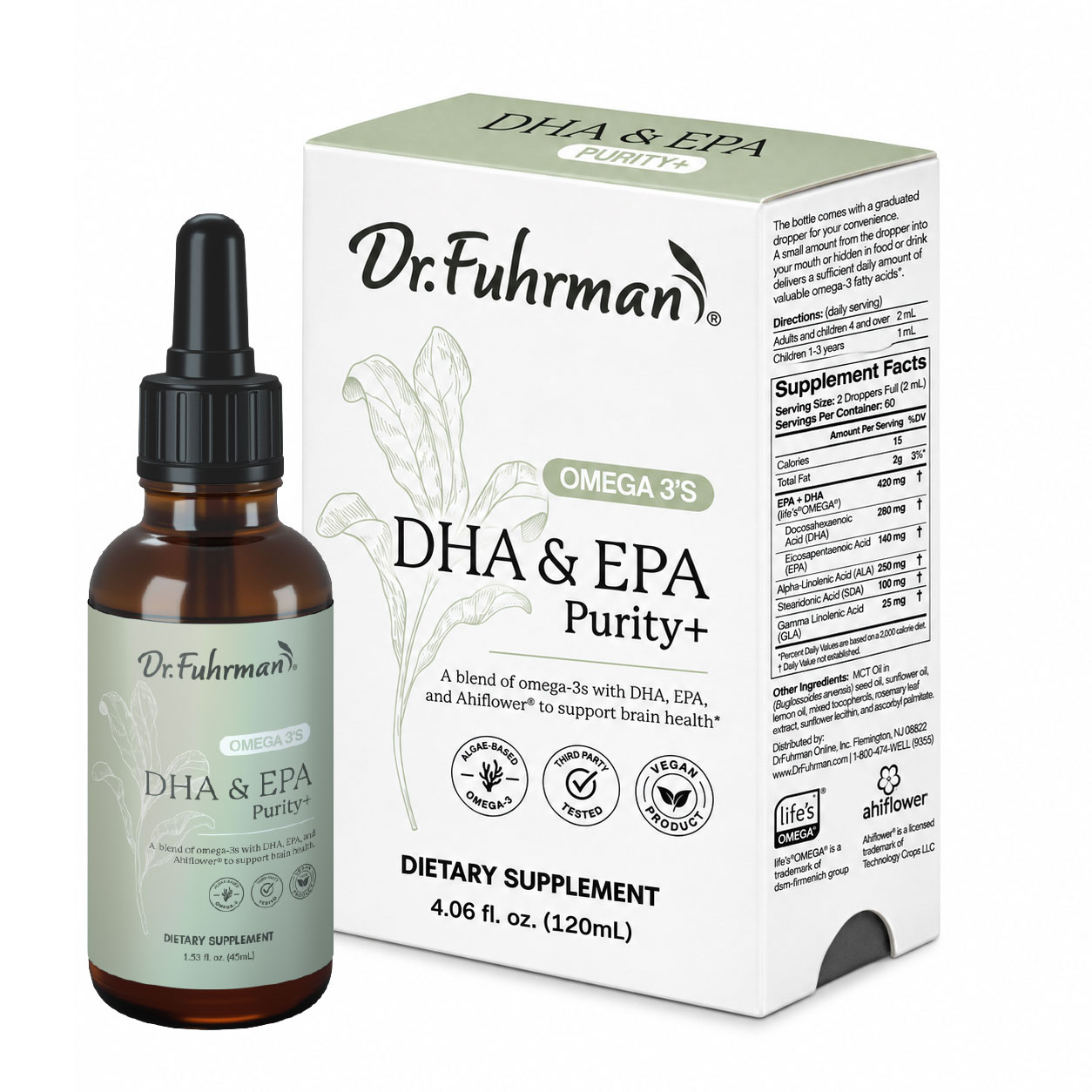
Based on this evidence, I now recommend an omega-3 index between 7% and 9%. In practice, I found that some family members, friends, and customers taking the original 263 mg dose did not reach 7% and had to take extra. My new formula, DHA & EPA Purity+, increases both DHA and EPA by about 60 percent, to 280 mg DHA and 140 mg EPA per serving, plus 100 mg SDA, 250 mg ALA, and 27 mg GLA from regeneratively farmed Ahiflower®. The 420 mg of DHA and EPA combined should be enough to move most people into the protective range, while staying still comfortably below the doses linked to atrial fibrillation risk.
My DHA & EPA Purity+ is packaged in dark glass and an opaque box, and refrigerated in our warehouse until it is shipped to you, to prevent oxidation and rancidity of these precious oils.
Sources:
Impact of Different Doses of Omega-3 Fatty Acids on Cardiovascular Outcomes: a Pairwise and Network Meta-analysis
The Omega-3 Index and relative risk for coronary heart disease mortality: Estimation from 10 cohort studies
Using an erythrocyte fatty acid fingerprint to predict risk of all-cause mortality: the Framingham Offspring Cohort
My recommendations
- Eat one tablespoon of ground flaxseed and one tablespoon of chia seeds daily, and make flax, chia, hemp seeds, and walnuts at least half of your daily nuts and seeds.
- Supplement with a clean, algae-derived source of DHA and EPA, ideally combined with SDA.
- Test your omega-3 index, aim for 7-9%, and adjust your dose over time based on your results.