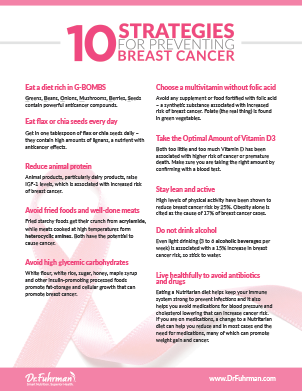
Ten strategies for preventing breast cancer

1. Eat a diet rich in G-BOMBS.
Following a high-nutrient diet rich in G-BOMBS, as described in my book Super Immunity protects against many chronic diseases, breast cancer included. Green vegetables and mushrooms are the most powerful anti-breast cancer foods. Take note that a vegetarian diet does not show protection against breast cancer as much as a diet rich in green vegetables, beans, mushrooms, onions, berries, nuts and seeds. It is the phytochemical nutrient density and diversity of the diet that offers the most dramatic protection against cancer, not merely the avoidance of meat or fat.1-5
Vegetables and fruits have been consistently associated with both reduced risk of breast cancer and improved survival of breast cancer patients.3,4,6-8 Cruciferous vegetables contain powerful anti-cancer compounds that halt the growth of breast cancer cells and promote excretion of estrogen.2,9,10 Mushrooms block tumor growth and have anti-estrogenic activity – regular consumption of mushrooms – as little as one mushroom per day – has been shown to decrease breast cancer risk by up to 60-70%.1,5,11 Organosulfur compounds in onions and garlic also prevent the development of cancers by detoxifying carcinogens, halting cancer cell growth, and preventing tumors from obtaining a blood supply.12
2. Eat flax or chia seeds every day.
Flax and chia seeds are the richest sources of lignans, phytochemicals with anti-estrogenic effects which also inhibit cell growth in breast tumors.13,14 In fact, in one notable study of women who were scheduled to have breast tumors removed, half ate a flax-containing muffin and the other half ate a control muffin daily, for 32-39 days until surgery. Their tumor tissue was analyzed, and even in this short timeframe, there was significant apoptosis (tumor cell death) and reduced cell proliferation of tumor cells in the flaxseed group.14
3. Reduce animal protein.
Consuming more protein and especially dairy products raises blood levels of insulin-like growth factor 1 (IGF-1), and elevated IGF-1 levels have been associated with increased in breast cancer risk in many studies.15 Higher fish consumption in women has also been linked to higher rates of breast cancer.16 Agricultural and industrial carcinogens, such as dioxins, accumulate in fatty tissues. Humans’ primary mode of exposure to these dangerous chemicals is from meat, poultry, fish, and dairy fat.17
4. Avoid fried foods and well-done meats.
Steaming vegetables, wokking or making vegetable soups should be the major extent of cooking. High temperature dry cooking produces potentially carcinogenic compounds – acrylamide (formed in starchy foods like French fries) and heterocyclic amines (formed in meats).18-20 For example, chicken cooked at high temperatures is known to contain a heterocyclic amine called PhiP, which is a breast carcinogen.21-23
5. Avoid high glycemic carbohydrates
A high-glycemic diet has been associated with greater risk of breast cancer and greater risk of recurrence in breast cancer survivors.24, 25 Insulin is a growth-promoting hormone, and chronic exposure to high-glycemic refined carbohydrates leads to chronic hyperinsulinemia, which could accelerate the growth of cancerous cells. This includes white flour, white rice, sugar, honey, maple syrup and other insulin-promoting processed foods.26
6. Choose a multivitamin without folic acid.
Make sure your multivitamin and other supplements do not contain folic acid. Also do not use nutritional yeast fortified with folic acid. Folic acid is found in most multivitamins and prenatal vitamins, and is associated with increased risk of breast cancer, whereas folate from natural food sources is associated with decreased risk.27-31 Folic acid is synthetic, not found in nature, whereas green vegetables are loaded with folate (the real thing).
7. Take the optimal amount of vitamin D3
Vitamin D helps to prevent cancer by opposing inflammation and proliferation of cancerous cells. In addition, vitamin D appears to have more specific breast cancer-preventive properties, based on studies showing that vitamin D has anti-estrogenic effects in breast cancer cells.32
Three-quarters of women who have breast cancer are vitamin D deficient, and maintaining sufficient blood vitamin D levels is associated with reduced risk of breast cancer diagnosis or recurrence.33-36 Some studies caution against vitamin D levels that are too high.37 Make sure you are taking the right amount by confirming with a 25(OH)D blood test. I advise aiming for the sweet spot of 30-45 ng/ml.
8. Stay lean and active.
An analysis of 73 different studies concluded that women with high levels of physical activity reduced their risk of breast cancer by 25%.38,39 Maintaining a healthy weight is also extremely important, since 17% of breast cancer cases have been attributed to obesity alone.40
9. Do not drink alcohol.
More than fifty studies have been conducted on the influence of alcohol on breast cancer risk. Even light drinking (one or fewer alcoholic drinks per day) is associated with increased risk; for example, data from the Nurses’ Health Study suggested that women consuming 3-6 alcoholic drinks weekly increased their breast cancer risk by 15% compared to non-drinkers.41,42 In breast cancer survivors, drinking 3-4 alcoholic beverages per week increased the risk of recurrence by 34%.43
10. Live healthfully to avoid antibiotics and drugs.
Eating a Nutritarian diet helps keep your immune system strong to prevent infections. One reason this is important is the risk associated with taking antibiotics: breast cancer risk has been found to increase with number of days of antibiotic use.44
A Nutritarian diet also helps you avoid medications for blood pressure and cholesterol lowering that can increase cancer risk. Statin drugs are associated with a greater risk of breast cancer in older women.45 Likewise, calcium channel blockers and diuretics (used to lower blood pressure) have also been linked to greater risk.46,47