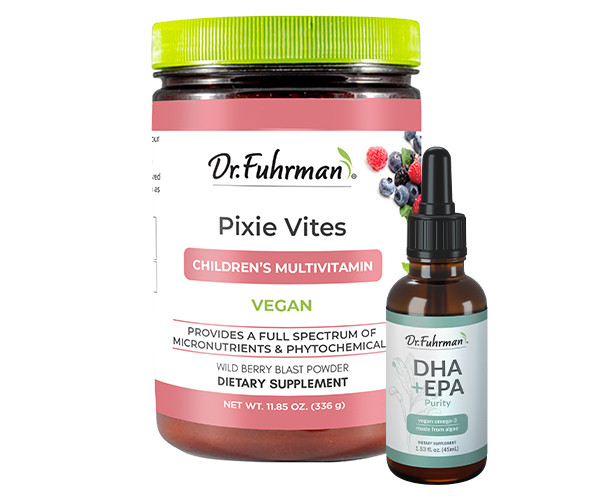
Dr. Fuhrman explains how making superior food choices for your children can help to disease-proof their future.
Read More |
Dr. Fuhrman’s Pixie Vites
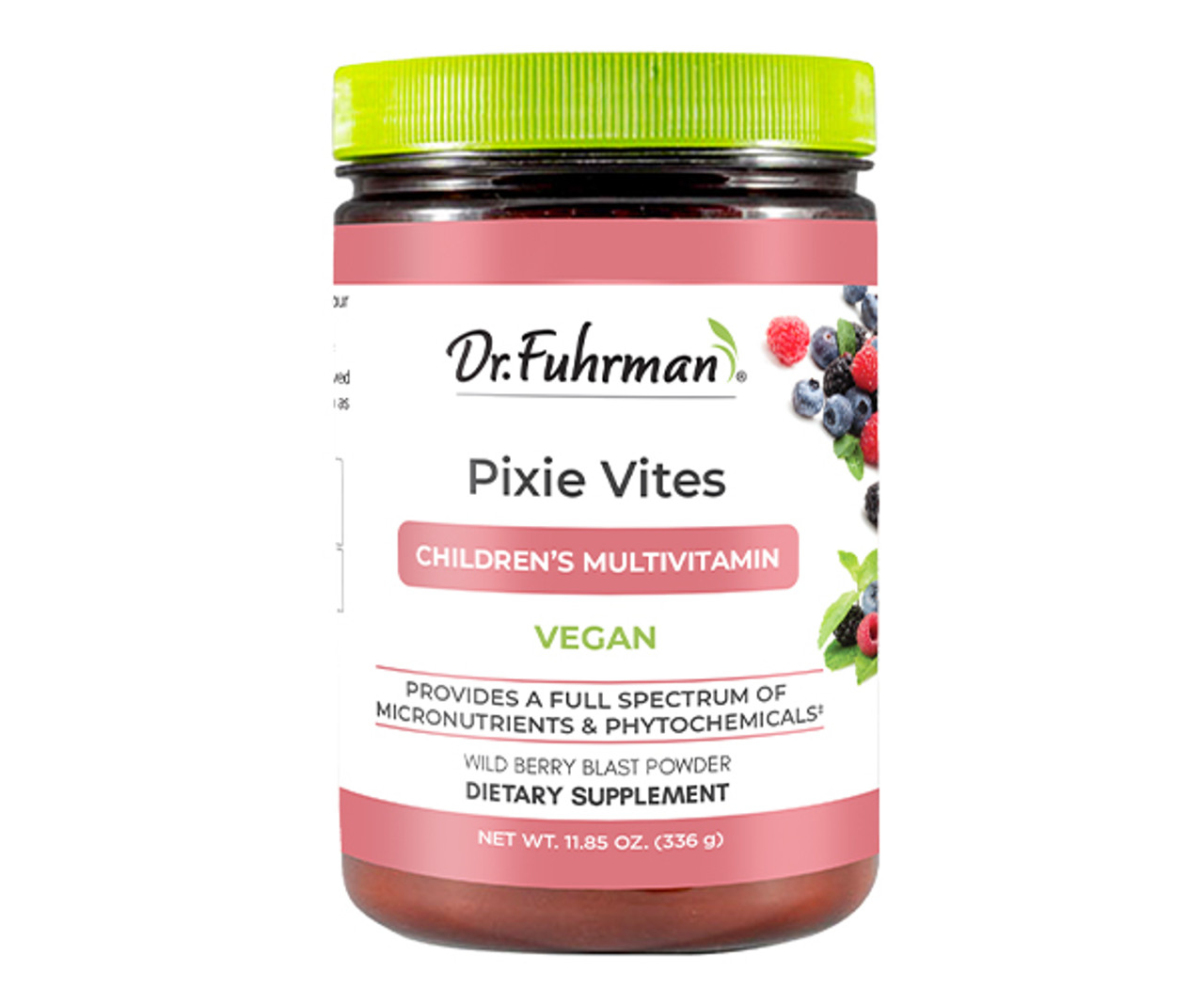
Dr. Fuhrman's Pixie Vites are a great-tasting, high quality, whole food-based, complete children's multivitamin and mineral supplement. Even when parents provide healthful foods, children don't always eat well-balanced meals. Pixie Vites provide added insurance that children are getting the essential nutrients they need to grow up healthy. In addition, Dr. Fuhrman teaches that vitamins and minerals are not the only beneficial substances in natural foods — there are also thousands of phytochemicals in perfect balance that act synergistically to promote excellent health. Pixie Vites provide antioxidant and phytochemical protection from real foods. Pixie Vites contain 30 whole food extracts including blueberry, broccoli, kale, and pomegranate, supplying a spectrum of nutrients in their natural setting.
Dr. Fuhrman's Pixie Vites formulation adds additional benefits to an already comprehensive children's multivitamin and mineral: this formulation contains real folate, rather than folic acid; plus there is no added sugar — fruit and vegetable concentrates alone provide a great wild berry flavor.
What is unique about Pixie Vites?
The composition of Pixie Vites reflects Dr. Fuhrman's high standards for supplement safety and quality:
- Real folate, not folic acid.
- NO added sugar — kid-friendly wild berry flavor from fruit extracts, not sweeteners.
- NO isolated vitamin A or beta carotene — natural carotenoids from whole food extracts
- NO artificial sweeteners, colors or preservatives.
- Each scoop contains 30 fruit & vegetable extracts.
- Dissolves easily into food or drink
- Free of common allergens (NO wheat, dairy, gluten, or soy)
Pixie Vites DO NOT contain vitamin A or beta-carotene - potentially harmful ingredients that are included in most children's multivitamins.
Vitamin A or beta-carotene in isolated forms typically found in supplements, rather than their naturally occuring forms obtained from food may, interfere with the absorption of other crucially important carotenoids, such as lutein and lycopene, thus potentially increasing cancer risk. High carotenoid consumption from foods has been shown to decrease the risk of chronic diseases; in contrast, beta-carotene supplements have not been shown to have beneficial effects against cardiovascular disease or cancer. A beta-carotene supplement is a poor substitute for the broad assortment of carotenoid compounds found in plants.1,2
Pixie Vites contain real folate, not folic acid
Folate is a B vitamin found naturally in foods, especially green vegetables. Folic acid, however, is not found in natural foods — it is the synthetic form found in most supplements and in enriched refined grain products. Folate is essential for several chemical reactions related to DNA synthesis and DNA repair.3 Getting adequate folate is essential for good health, but according to several studies, too much synthetic folic acid could be harmful. Excess folic acid from supplements and fortified foods is associated with impaired immune function and several cancers.3-5
What is the difference between folate and folic acid?
Natural folates are found in foods, especially green vegetables. Synthetic folic acid is twice as bioavailable than natural folate, which means that taking synthetic folic acid poses the risk of excess.6 Also, a significant amount of folic acid is not properly metabolized before it is absorbed, and circulating unmetabolized folic acid may interfere with normal folate metabolism and present additional risks.3
Pixie Vites contain 5-methyltetrahydrofolate, the most common folate found in foods
Unfortunately, it is unrealistic to assume that all children always eat sufficient green vegetables, so Dr. Fuhrman has added a small dose of folate in its natural form to the newest formula of Pixie Vites. Tetrahydrofolates are the biologically active forms of the folate - synthetic folic acid is not an active form, and must be modified before it can be used by the body as folate.3 5-methyltetrahydrofolate is the common form of folate found in natural foods, and the safe form of folate normally found circulating in the blood.77
|
Directions:
Mix 1 or 2 scoops with water, food, or beverage of choice.
|
Supplement Facts:
Serving Size: 2 scoops (5g) Suggested Daily Use : one scoop for children less than 4 and two scoops for over 4. |
| |
| |
Amount Per Serving
|
% Daily Value
Children ≤ 4 years
|
% Daily Value
Adults > 4 years
|
| Calories |
10
|
|
|
| Total carbohydrate |
3 g
|
†
|
1%*
|
|
| Sugars |
2 g
|
†
|
†
|
| Vitamin C (as ascorbic acid) |
50 mg
|
125%
|
83%
|
| Vitamin D (as cholecalciferol) |
400 IU
|
100%
|
100%
|
| Vitamin E (as natural mixed tocopherols) |
10 IU
|
100%
|
33%
|
| Vitamin K (as phylloquinone) |
20 mcg
|
†
|
25%
|
| Thiamin (as thiamin mononitrate) |
0.75 mg
|
107%
|
50%
|
| Riboflavin |
0.75 mg
|
94%
|
44%
|
| Niacin (as niacinamide) |
5 mg
|
56%
|
25%
|
| Vitamin B6 (as pyridoxine HCL ) |
1 mg
|
143%
|
50%
|
| Folate (as Folate (Quatrefolic™ (6S)-5-methyltetrahydrofolate glucosamine salt (vegan, shellfish-free)]) |
200 mcg
|
100%
|
50%
|
| Vitamin B12 (as methylcobalamin) |
10 mcg
|
333%
|
167%
|
| Biotin |
100 mcg
|
67%
|
33%
|
| Pantothenic acid (as D-calcium pantothenate) |
5 mg
|
100%
|
50%
|
| Calcium (as calcium citrate and calcium ascorbate) |
300 mg
|
38%
|
30%
|
| Iron (as ferrous fumarate) |
5 mg
|
50%
|
28%
|
| Iodine (as kelp) |
50 mcg
|
71%
|
33%
|
| Magnesium (as magnesium oxide) |
100 mg
|
50%
|
25%
|
| Zinc (as zinc picolinate and zinc amino acid chelate) |
5 mg
|
63%
|
33%
|
| Selenium (as sodium selenite) |
25 mcg
|
†
|
36%
|
| Copper (as copper citrate) |
0.6 mg
|
60%
|
30%
|
| Manganese (as amino acid chelate) |
1 mg
|
†
|
50%
|
| Chromium (as chromium amino acid chelate) |
|
†
|
42%
|
| Molybdenum (as sodium molybdate) |
25 mcg
|
†
|
33%
|
| Choline (as choline bitartrate and with cauliflower) |
2 mg
|
†
|
†
|
| Inositol |
50 mcg
|
†
|
†
|
| Vanadium (as vanadyl sulfate) |
5 mcg
|
†
|
†
|
| Boron (as boron citrate) |
0.5 mcg
|
†
|
†
|
† Daily Value(DV) not established.
* based on 2,000 calorie diet.
Other ingredients: fruit vegetable botanical blend [apple, (bioflavonoid complex , hesperidin, rutin, quercetin), blueberry, pineapple, broccoli, carrots, apple, orange, tomato, brussels sprouts, cauliflower, blueberry, celery, grape, grapefruit, kale, plum, raspberry, spinach, strawberry, watermelon, radish, lemon, lime, cantaloupe, cherry, onion, papaya, peach, pear, leek, yellow pepper, pomegranate], natural flavors, beet color, citric acid, grape skin extract, vegetable magnesium stearate, and medium chain triglycerides.
- Keep out of reach of children.
- Store at 15–30°C (59–86°F).
- Protect form heat, light and moisture.
- Do not purchase if seal is broken.
These supplements have not been evaluated by the Food and Drug Administration.
Products listed are not intended to diagnose, treat, cure or prevent disease.
References:
1 Goodman GE: Lung cancer. 1: prevention of lung cancer. Thorax 2002;57:994-999.
2 Mayne ST: Beta-carotene, carotenoids, and disease prevention in humans. FASEB J 1996;10:690-701.
3 Smith AD, Kim YI, Refsum H: Is folic acid good for everyone? Am J Clin Nutr 2008;87:517-533.
4 Troen AM, Mitchell B, Sorensen B, et al: Unmetabolized folic acid in plasma is associated with reduced natural killer cell cytotoxicity among postmenopausal women. J Nutr 2006;136:189-194.
5 Ulrich CM: Folate and cancer prevention: a closer look at a complex picture. Am J Clin Nutr 2007;86:271-273.
6 Pitkin RM: Folate and neural tube defects. Am J Clin Nutr 2007;85:285S-288S.
7 Pietrzik K, Bailey L, Shane B: Folic acid and L-5-methyltetrahydrofolate: comparison of clinical pharmacokinetics and pharmacodynamics. Clin Pharmacokinet 2010;49:535-548.
|
|